Consensus
AI-powered academic search engine for evidence-based research.
Executive Summary
Consensus is an AI-powered academic search engine built on a database of over 220 million peer-reviewed research papers. It helps researchers, students, and professionals quickly review literature, understand complex topics, and synthesize findings by providing instant summaries and evidence-based answers with citations. The platform aims to save time and enhance academic rigor by grounding every response in scientific research and offering tools for efficient literature review. It differentiates itself by prioritizing factual clarity and scientific integrity over speculation, making it a trusted tool for academic and professional use.
Use Cases
- Conducting comprehensive literature reviews for academic papers and theses.
- Finding evidence and supporting data for research projects and presentations.
- Quickly understanding complex scientific topics and research findings.
- Identifying research gaps and unexplored areas for new studies.
- Validating clinical treatments and preparing evidence-based medical papers.
- Streamlining the research workflow for students and academics.
Features
Visibility
- Consensus Meter: A visual tool that indicates the level of agreement or disagreement among research papers on a specific yes/no question.
- Study Snapshots: Provides key details and insights from research papers at a glance, such as methodology and findings, to quickly assess relevance.
- Advanced Search Filters: Allows users to refine search results by specifying criteria like timeframes, populations, study designs, and more using natural language.
- Research Hub: A personal workspace to organize research threads, save papers, and manage literature for ongoing projects.
Intelligence
- Instant Summaries: Generates concise, evidence-based summaries of findings from thousands of peer-reviewed studies in seconds.
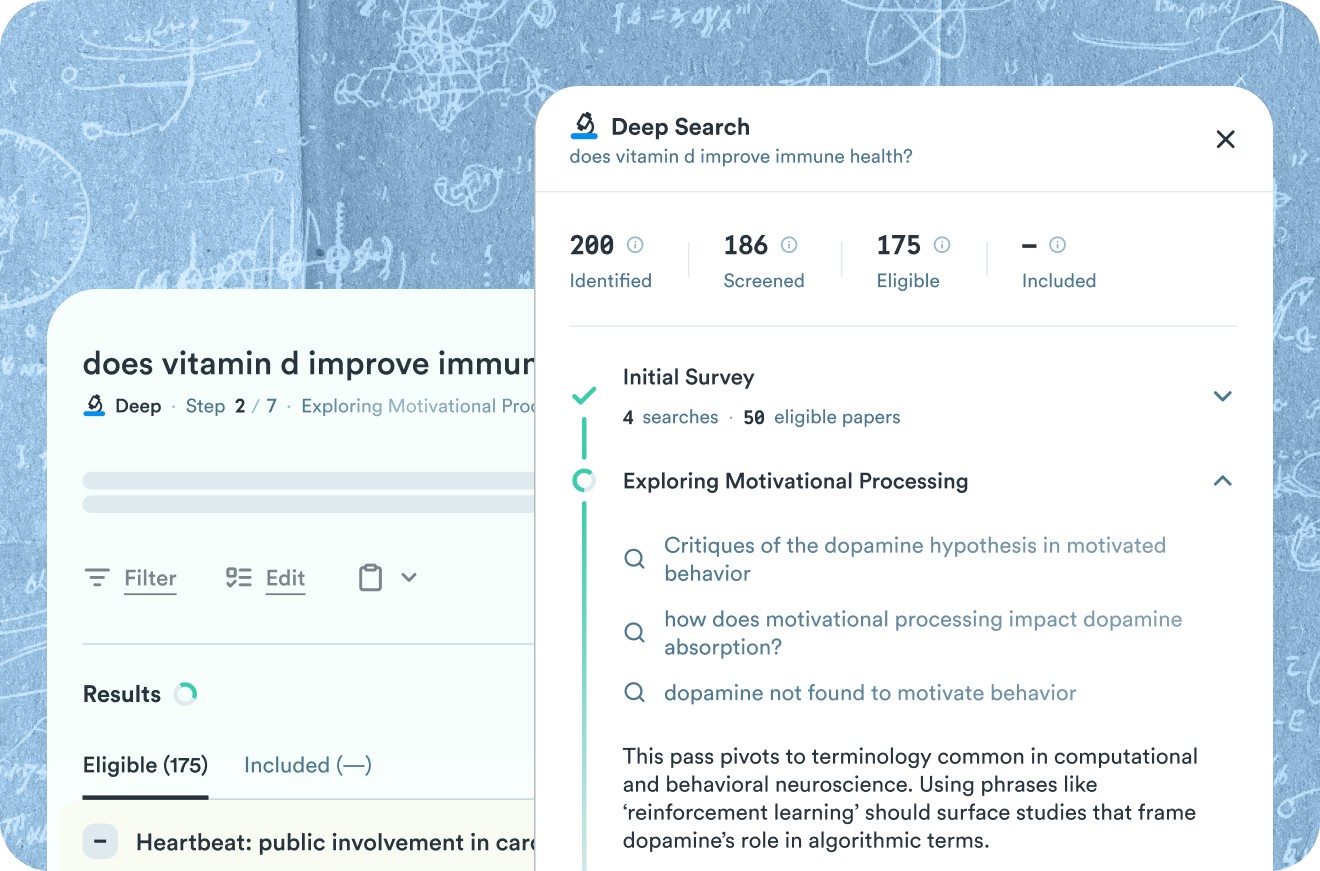
- Deep Search: Automates comprehensive literature reviews by expanding key terms, identifying conflicting arguments, and exploring citation graphs.
- Ask Paper: Enables users to interact directly with open-access PDFs, asking questions and extracting specific information from individual papers.
- AI-Powered Filters: Applies sophisticated filters to search results based on natural language prompts, enhancing precision and relevance.
- Research Gap Identification: Helps users discover unexplored areas or gaps in existing research, facilitating the development of new research questions.
Support
- Help Center & Support Chat: Provides resources and direct chat support for user inquiries and assistance.
- Community Engagement: Fosters a user community through platforms like Discord for discussions and shared learning.
- University Access Programs: Partners with university libraries to provide access and resources to students and faculty.
Technical Specifications
- Architecture
- Cloud-native SaaS
- Deployment
- Cloud/SaaS
- Authentication
- Account-based login with social sign-in options
- API Available
- Yes
- MCP Server
- Yes
AI/ML Stack
- NLP
- Machine Learning
- LLM
Integrations
- Semantic Scholar
- OpenAlex
- PubMed
- Zotero
- Mendeley
Security & Compliance
Encryption: Not explicitly detailed, but standard cloud security practices are implied.
Pricing
- Model
- Tiered subscription (Free, Pro, Deep, Teams, Enterprise)
- Starting Price
- Free; Pro $12/mo (annual) or $20/mo (monthly); Deep $45/mo (annual) or $65/mo (monthly); Teams and Enterprise custom pricing
- Target Customer
- Researchers,Students,Clinicians,Universities,Enterprises
- Contract Type
- Monthly, Annual
- Free Trial
- Yes, Free plan with monthly limits on advanced features. (credit card required)
About Consensus
Consensus is an AI-powered research discovery platform and search engine for scientific literature, founded in 2020 by Christian Salem and Eric Olson. Headquartered in Boston, United States, the company aggregates and summarizes findings from academic papers, preprints, and conference proceedings to provide evidence-based answers. Its mission is to make scientific research more accessible for researchers, clinicians, and enterprise users, simplifying the process of finding, understanding, and trusting scientific information.
Alternatives to Consensus
- Consensus API by Consensus — Instant access to relevant academic papers and peer-reviewed citations via API.
- Deep Research by Benchling — Answer complex scientific questions by reasoning over experimental data and literature.
- Deep Review by SciSpace — Synthesize literature at scale, extracting key findings and identifying gaps across thousands of PDFs.
- Gemini by Google — Google's AI assistant for writing, planning, brainstorming, and more.
- Ginkgo Datapoints by Ginkgo Bioworks — Transforming AI model training in biology with large-scale, automated lab data.
- Ginkgo R&D Solutions by Ginkgo Bioworks — Accelerate biotech R&D with customizable solutions for protein engineering, nucleic acid design, and cell-free systems.
- Hoppscotch Browser Extensions by Hoppscotch — Enhance your Hoppscotch API development workflow with browser extensions for proxying and CORS fixes.
- ideaPoint by Anaqua, Inc. — Revolutionize innovation management and accelerate IP programs with custom workflows.