Hoppscotch
The open-source API development ecosystem for building, testing, and sharing APIs.
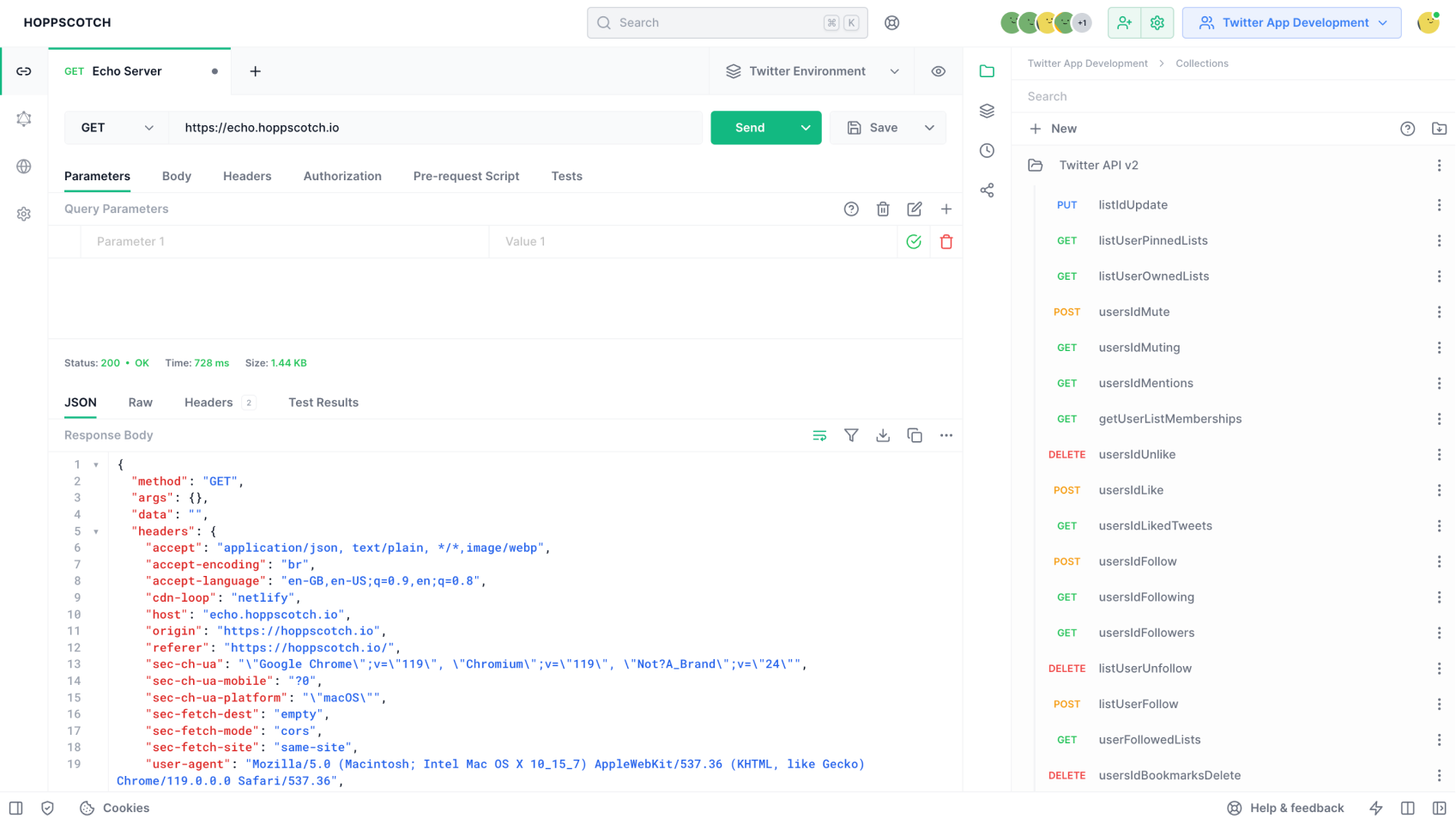
Executive Summary
Hoppscotch is a lightweight, open-source API development ecosystem that provides a web-based alternative to traditional API clients like Postman. It enables individual developers and teams to efficiently build, test, and share APIs across various protocols including REST, GraphQL, and WebSockets. The platform offers both free cloud-based and self-hosted options, providing flexibility, enhanced control over data, and robust collaboration features for accelerated API development workflows.
Use Cases
- Developing and testing RESTful APIs with various HTTP methods and authentication schemes.
- Building and testing GraphQL queries and mutations against GraphQL endpoints.
- Interacting with real-time APIs using WebSockets, Socket.IO, MQTT, and Server-Sent Events.
- Collaborating on API projects within teams using shared collections, environments, and workspaces.
- Automating API test suites and integrating them into CI/CD pipelines using the Hoppscotch CLI.
- Migrating existing API collections and requests from tools like Postman, Insomnia, or cURL.
Features
Visibility
- Request History: Automatically saves a history of all sent API requests and responses for easy access and re-use.
- Admin Dashboard: Provides a centralized interface for managing workspaces, users, and their roles within self-hosted Community and Enterprise editions.
- Audit Logs: Tracks all activities within a workspace, detailing who did what and when, available in the Enterprise edition.
Intelligence
- Pre-request Scripting: Allows users to write JavaScript code to modify requests before they are sent, enabling dynamic data generation and complex authentication flows.
- Post-request Testing: Enables writing JavaScript assertions to validate API responses, check status codes, parse data, and set environment variables for chained requests.
- Environment Variables: Supports defining and managing variables for different environments, allowing dynamic values in requests and tests without hardcoding.
- Collection Runner: Automates the execution of multiple requests within a collection, supporting iterations and data feeds, and can be integrated into CI/CD pipelines via CLI.
Support
- Community Support: Access to community forums, Discord, Telegram, and GitHub discussions for assistance and knowledge sharing.
- Dedicated Support: Organization and Enterprise plans include dedicated support from the Hoppscotch team, offering critical response and best practice guidance.
- Comprehensive Documentation: Extensive online documentation and guides are available for all features and deployment options.
Technical Specifications
- Architecture
- Open-source, web-based, Progressive Web App (PWA), desktop clients (Mac, Windows, Linux), and Command-Line Interface (CLI). Supports cloud-native SaaS and self-hosted deployments via Docker.
- Deployment
- Cloud/SaaS
- Authentication
- SSO, SAML 2.0 (Enterprise), OIDC (Enterprise), OAuth 2.0, Basic Auth, Bearer Tokens, Digest Auth, GitHub, Google, Microsoft, Email.
- API Available
- No
- MCP Server
- No
Integrations
- GitHub
- GitLab
- Docker
- Kubernetes
- OAuth providers
Security & Compliance
Encryption: Local-first data storage with no tracking or analytics. Specific encryption standards like AES-256 or TLS 1.3 are not explicitly detailed in public information.
Pricing
- Model
- Freemium (Free Cloud/Community) and Tiered Subscription (Organization/Enterprise)
- Starting Price
- Free: $0. Organization: $6/user/month (billed annually). Enterprise: $19/user/month (billed monthly).
- Target Customer
- Individuals, SMB, Mid-Market, Enterprise
- Contract Type
- Annual (discount for Organization plan), Monthly (Enterprise plan)
- Free Trial
- Yes, Perpetual (Free tier), Custom demo (Enterprise) (credit card required)
About Hoppscotch
Hoppscotch is an open-source API development ecosystem that provides a lightweight and fast alternative to traditional API clients like Postman. It offers tools for building, testing, and sharing APIs across various protocols, including HTTP, GraphQL, WebSocket, Socket.IO, and MQTT. The platform is trusted by millions of developers and supports both cloud and self-hosted deployments.
Alternatives to Hoppscotch
- Hoppscotch CLI by Hoppscotch — Automate API workflows and run collections directly from your terminal and CI/CD pipelines.
- Hoppscotch Desktop App by Hoppscotch — Helps you create requests faster, saving precious time on development.
- Hoppscotch Enterprise Edition by Hoppscotch — Securely manage, organize, and accelerate API-first development at scale for enterprises.
- IBM Watsonx by IBM — An enterprise-ready AI and data platform for building, training, and deploying AI models.
- Inflection for Enterprise by Pi — Human-centered AI for scalable enterprise applications.
- Java by Oracle — The #1 development platform, reducing costs and driving innovation for applications.
- Logically AI PDF & Text Summarizer by Afforai (now Logically.app) — AI-powered research workspace for students & academics.
- Lyzr Agent Studio by Lyzr AI — Low-code platform for building and deploying secure, autonomous AI agents for enterprises.